
With the ability to regulate the potential difference between two electrodes, potentiostats enable researchers to delicately probe the intricacies of electrochemical systems, uncovering the underlying mechanisms that govern energy storage, conversion, and transfer.
But what sets high-precision potentiostats apart from their more conventional counterparts, and how do they facilitate groundbreaking discoveries in fields like battery development, fuel cells, and bioelectrochemistry?
By providing an unprecedented level of control and accuracy, these advanced potentiostats empower scientists to push the boundaries of electrochemical research, driving innovation and advancements in various industries.
As the demand for sustainable energy solutions and cutting-edge technologies continues to grow, the importance of high-precision potentiostats in unlocking the secrets of electrochemistry cannot be overstated.
Understanding the Role of Potentiostats in Electrochemical Research Applications
Potentiostats play a crucial role in electrochemical research, enabling scientists to control and measure the potential difference between electrodes in an electrochemical cell.
This capability is essential for various applications, including corrosion studies, battery development, and sensor research.
By regulating the electrode potential, researchers can gain valuable insights into electrochemical reactions and processes.
- Key applications of potentiostats include electroplating, electrosynthesis, and bioelectrochemistry.
- In-situ measurements can be performed using potentiostats, allowing for real-time monitoring of electrochemical reactions.
- Advanced potentiostats can also be used for electrochemical impedance spectroscopy, providing detailed information about the electrochemical properties of materials.
Exploring High-Precision Potentiostat Instruments for Accurate Voltage Control
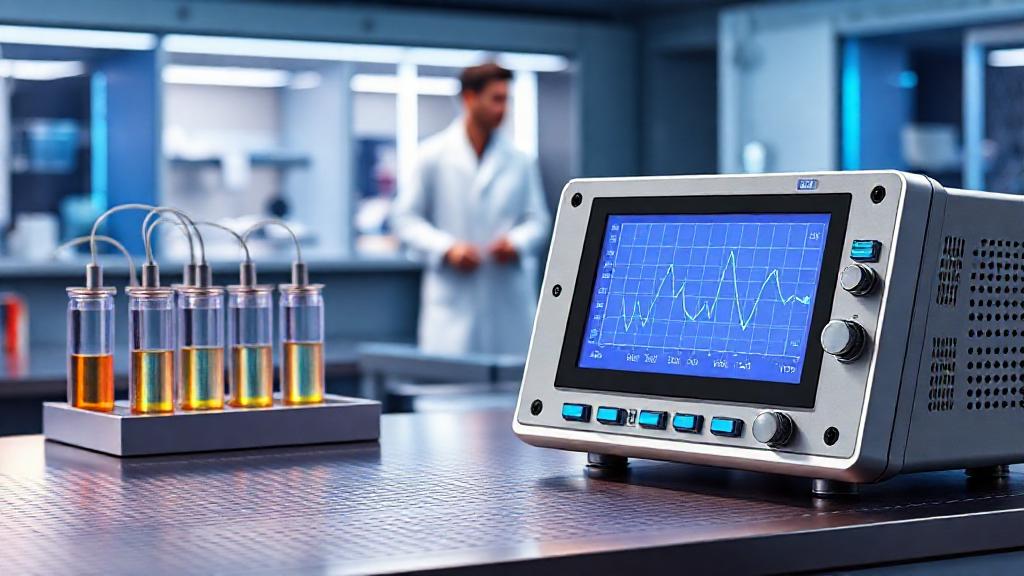
When it comes to high-precision potentiostats, the market offers a range of options, each with its unique features and capabilities.
Understanding the specifications and applications of these instruments is crucial to selecting the right one for research needs.
A high-precision potentiostat can be a significant investment, but it’s essential for achieving accurate and reliable results in electrochemical research.
Investigating Electrochemical Reactions with Three-Electrode Setup Configurations
In a groundbreaking study, researchers utilized a three-electrode setup to investigate the electrochemical properties of a new sustainable energy storage material, uncovering promising results that could revolutionize the field of renewable energy.
The setup consisted of a working electrode, a counter electrode, and a reference electrode, allowing for precise control and measurement of the electrochemical reactions.
This innovative approach enabled the team to optimize the material’s performance and identify potential areas for improvement.
By exploring the intricacies of electrochemical reactions, the researchers paved the way for the development of more efficient and sustainable energy solutions.
Operating Potentiostats in Potentiostatic or Galvanostatic Mode for Research
Operating a potentiostat in either potentiostatic or galvanostatic mode is akin to being the conductor of an electrochemical orchestra, where the instrument’s settings dictate the harmony between the working electrode, counter electrode, and reference electrode.
In potentiostatic mode, the potentiostat acts as a precise voltage regulator, maintaining a constant potential difference between the working and reference electrodes.
This mode is particularly useful for studying electrode kinetics, where the current flowing through the cell is measured as a function of the applied potential, providing valuable insights into the electrode’s behavior.
Selecting Suitable Potentiostats for Electrochemical Research
When it comes to selecting suitable potentiostats, understanding the voltage and current range requirements is crucial.
The voltage range of a potentiostat determines its ability to control the potential of an electrode, while the current range affects its ability to supply or measure current.
Potentiostats with higher voltage ranges are typically used for applications such as electrochemical corrosion testing, while those with lower voltage ranges are suited for applications like battery testing.
Evaluating the Importance of Reference Electrode Stability in Electrochemical Measurements
Ensuring accurate electrochemical measurements relies heavily on reference electrode stability.
- Influencing the overall precision of electrochemical experiments with stable reference electrodes
- Providing a consistent potential for precise measurements, reducing errors in data interpretation
- Maintaining a stable environment to minimize electrode drift and potential fluctuations
- Enhancing the reliability of electrochemical measurements for various applications, including corrosion monitoring and electroanalysis
- Optimizing electrode design and materials to improve stability and performance in diverse environments
Using Galvanostats for Constant Current Control in Electrochemical Experiments
Constant current control is crucial in electrochemical experiments — allowing researchers to accurately measure and analyze various electrochemical reactions.
A galvanostat plays a significant role in ensuring the accuracy and reliability of electrochemical experiments.
In order to achieve precise results, it is essential to choose a galvanostat that meets the specific requirements of the experiment, taking into account factors such as current range and resolution.
Applying Potentiostats in Various Fields including Electrochemistry and Biochemistry Research
Contrary to the common perception that potentiostats are limited to electrochemistry, their applications extend far beyond.
In reality, potentiostats play a crucial role in various fields, including biochemistry research.
“The use of potentiostats in biochemistry research has revolutionized our understanding of biological systems, enabling us to study the electrochemical properties of biomolecules with unprecedented precision”
Optimizing Potentiostat Performance with User-Friendly Software and Dedicated Electrodes
The integration of user-friendly software and dedicated electrodes in potentiostat systems has significantly enhanced their performance, allowing for more precise control over electrochemical reactions and improved data analysis.
This synergy enables researchers to optimize experimental conditions, minimize errors, and increase the accuracy of their results, thereby facilitating advancements in various fields such as electrochemistry, materials science, and biotechnology.
As we delve into the realm of electrochemical research, the significance of high-precision potentiostats becomes increasingly evident, much like the intricate dance of electrons at the electrode interface.
The precision and control offered by these devices have the potential to unlock new avenues of discovery, from the development of more efficient energy storage systems to the creation of innovative biosensors.
With the ever-evolving landscape of electrochemical research, one cannot help but wonder what breakthroughs the future holds for scientists equipped with these powerful tools, and how they will continue to shape our understanding of the complex interplay between electrodes, ions, and molecules.